October 10 2026
CWBEOur Facilities
CWBE is based at the University of Bath and received a multi-million-pound investment to develop state-of-the-art facilities and infrastructure. This award, from Research England’s Expanding Excellence in England funding stream, together with funding from the University of Bath, has allowed significant investment in people, infrastructure and technology.
Mass Spectrometry facility
High Resolution – Xevo MRT
Our Xevo MRT is a state-of-the-art benchtop Quadrupole-Time of Flight (Q-TOF) instrument equipped with Multi Reflecting TOF (MRT) technology that allows for extremely high-resolution analysis while maintaining high scan rates and sub-ppb mass accuracy. This level of resolution and mass accuracy allows us to have extreme confidence in the identification of targeted and untargeted analytes, through both data dependent (DDA) and data independent (DIA) analysis modes.

Triple Quadrupole – Xevo TQ Absolute and Xevo TQD
Our triple quadrupole instruments allow for highly sensitive targeted analysis of small molecules – down to low parts per billion levels of concentration. Our workhorse, the Xevo TQD, has been in regular operation for over a decade and continues to supply robust MRM data for routine analysis. Our new addition to CWBE, the Xevo TQ Absolute, provides the same level of robustness while increasing our sensitivity by approximately 1000x depending on the target compound.

Ultra Performance Liquid Chromatography (UPLC)
We have two Acquity Premier UPLC systems that can interface with the Xevo TQ Absolute and Xevo MRT. The Premier systems have a unique coating inside all of the internal tubing, increasing analyte recovery (and therefore sensitivity) and allowing for more reliable PFAS analysis.

Nano-LC
Our Acquity M-Class system runs at accurately measured flow rates of microliters to nanoliters per minute, around 50 -100 times slower than the UPLC systems. While this increases chromatographic run times, sensitivity and analyte separation is dramatically increased and is particularly useful for proteomic research. The M-Class can be connected to any of our mass spectrometers but is ideally coupled with the Xevo MRT for proteomic applications.

Supercritical Fluid Chromatography (SFC)
Our Waters UPC2 SFC system uses supercritical carbon dioxide as a mobile phase, as opposed to the water used in typical UPLC analyses. As supercritical CO2 has a higher solvating power than water, and a higher density than the nitrogen used as a mobile phase in APGC, it acts as an analytical bridge that can separate both polar and non-polar compounds in addition to the separation of chiral compounds. The UPC2 can be operated as a standalone system with a UV detector or coupled to our Xevo TQD.

Atmospheric Pressure Gas Chromatography (APGC)
Our Waters APGC system utilises a chemical ionisation source to create radical analyte species (or M+ ions). As opposed to standard GC electron ionisation sources, this is a soft ionisation source that boosts our sensitivity by minimising in-source fragmentation. Apart from a standard split/splitless inlet, the system is equipped with a programmable temperature vaporizing (PTV) inlet, allowing for cryo-cooling and temperature ramping of the inlet. The APGC is perfect for analysing non-polar volatile compounds, and is coupled with our TQ Absolute.

Biosciences suite
Andrew + Pipetting robot
Our Andrew+ Robot offers fully automated liquid handling using electronic pipettes and labware holders called Dominos. This increases reproducibility by eliminating most human errors through laboratory automation, and boosts productivity by combining flexible singlechannel pipetting with efficient multichannel throughput.

PCR facility
Our Biomark X9 Real-Time PCR System is a fully integrated, standalone benchtop system that automates everything from array priming to qPCR cycling and reading. It is a sensitive, high-throughput molecular tool that enables simultaneous surveillance of pathogens, antibiotic resistance genes, and mobile genetic elements in wastewater, providing valuable insights into infectious disease transmission, antimicrobial resistance trends, and community health status.

Gel documentation and fluorescence imaging
Our Syngene InGenius 5 is a compact, economical benchtop gel documentation and fluorescence imaging system designed for DNA, RNA, and protein gels. In CWBE, we use it to visualise and photograph DNA bands after agarose gel electrophoresis and to document laboratory results for reporting and publication.

Colony counter
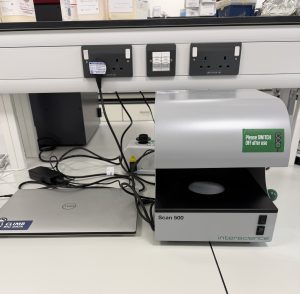
Our Interscience Scan 500 is an automatic colour colony counter and inhibition zone reader designed for research laboratories. We use the colony counter to count and analyse microbial colonies growing on agar plates. This helps us to obtain accurate, fast, and reproducible measurements of bacterial or fungal growth.